

Winter Walking Confidence: Ankles, Hips, and the 5-Minute Routine for Steadier Steps
Updated: Feb 16
Winter brings beautiful snowfalls—but it also brings slippery driveways, icy curbs, and slick store entrances. If you’ve ever felt your confidence drop the moment temperatures dip, you’re not alone.
Many older adults notice that walking feels less steady in winter, even if they’ve never had a fall. The good news? Improving balance in winter doesn’t require complicated equipment or long workouts. With the right focus—especially on your ankles and hips—and a simple daily routine, you can build steadier walking and greater confidence all season long.
Let’s break down why winter challenges balance, what the science says, and how to take practical steps that fit real life.
Why Winter Walking Feels Harder (Even If You’re Active)
Walking on dry, flat ground is very different from navigating:
Uneven or icy sidewalks
Sloped driveways
Tall curbs covered in snow
Wet tile floors at building entrances
These conditions demand quick balance reactions. Research shows that when the surface is unpredictable, the body relies heavily on ankle and hip strategies to prevent a fall (Horak & Macpherson, 1996).
If these systems are weak or slow to respond, you may feel:
Wobbly when stepping outside
Hesitant at curbs
Less confident walking without holding onto something
This is often mistaken as “just getting older,” but it’s usually a trainable balance issue, not an inevitable decline.
The Ankles: Your First Line of Defense Against Slips
Your ankles act like shock absorbers and steering wheels. When you slip slightly on ice or snow, small ankle movements help correct your balance before your body has to take a big step.
Studies show that ankle strength and proprioception (your body’s awareness of joint position) are strongly linked to balance and fall prevention in older adults (Menz et al., 2006).
Signs your ankles need attention:
Difficulty walking on uneven ground (grass, gravel etc.)
Feeling unstable when turning
Trouble standing on one foot
The Hips: Stability for Curbs, Slopes, and Quick Corrections
When ankle corrections aren’t enough—like on a steep driveway or curb—your hips step in. Strong hip muscles help you:
Recover from a larger slip
Control side-to-side movement
Stay upright when stepping over obstacles
Research consistently shows that hip strength and lateral stability are key factors in preventing falls (Shumway-Cook et al., 1997).
Winter walking challenges both systems at once, which is why targeted exercises matter more than general activity alone.
🎥 Watch this video from our Better Balance Series to see how Dr. Dawn explains what ankle, hip and stepping strategies are. This video playlist is a companion series for the Better Balance Workbook that can be purchased on Amazon or a version downloaded for free below.
The 5-Minute Routine for Steadier Walking (Winter-Friendly)
This simple routine focuses on ankles, hips, and real-life balance reactions. It takes about five minutes and works best when paired with a daily habit. We bet you will see a difference if you incorporate these 3 days a week.
1. Brushing-Teeth Calf Raises (1 minute)
Hold the counter lightly
Rise onto your toes, then slowly lower
Aim for 10–15 controlled repetitions
Why it helps: Builds ankle strength needed for push-off and quick corrections.
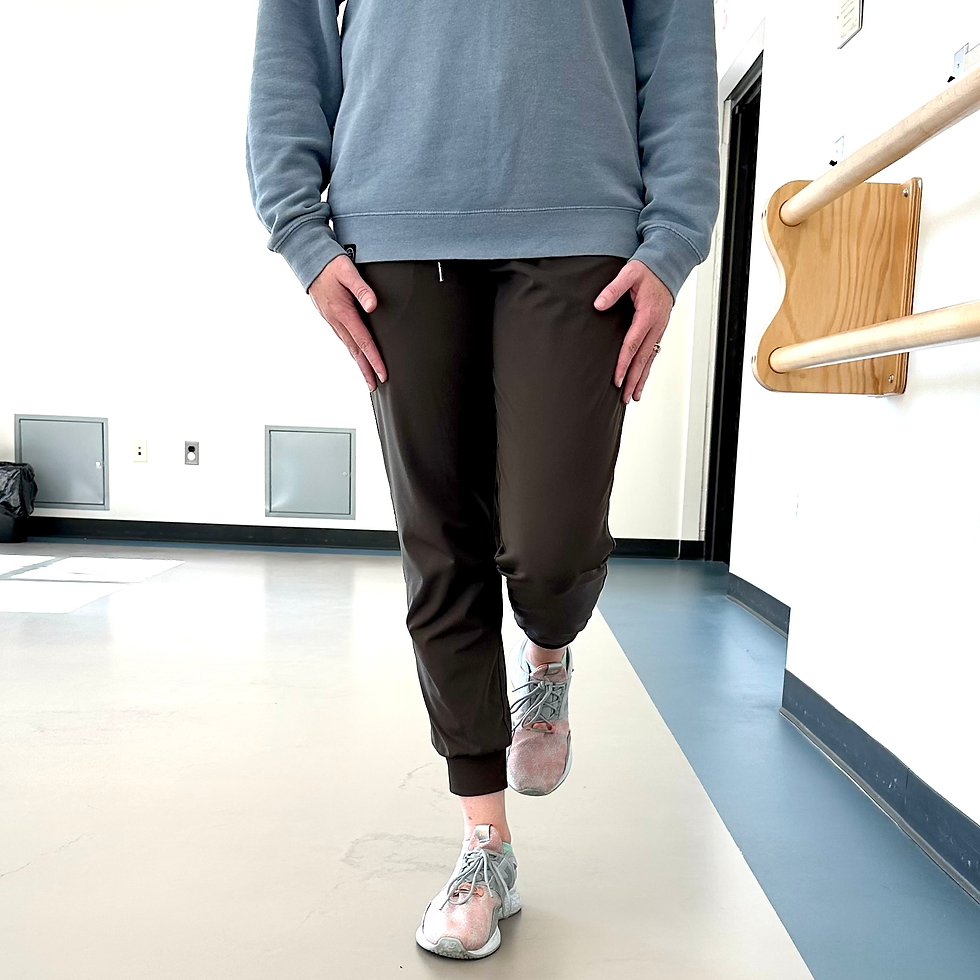
2. Supported Single-Leg Stance (1 minute each side)
Stand on one leg while lightly holding the counter
Keep posture tall
Progress by using less hand support
Why it helps: Improves ankle and hip coordination—critical for icy steps.
3. Side-Step Walks (1 minute)

Step sideways along the counter or wall (add a band for even more resistance)
Keep toes facing forward
Move slowly and with control
Why it helps: Strengthens hip muscles used for balance recovery.
4. Heel-to-Toe Standing (1 minute)

Stand with one foot directly in front of the other
Hold support as needed
Switch sides
Why it helps: Mimics narrow winter walkways and curbs.
Habit-Stacking Tip
Link this routine to something you already do daily—brushing your teeth, waiting for coffee to brew, or standing at the kitchen counter. Consistency matters more than intensity.
Why Personalized Balance Training Works Best
Research shows that home-based, individualized balance programs are especially effective for improving stability and reducing fall risk—particularly when exercises relate directly to daily activities (Sherrington et al., 2011).
That’s why generic “one-size-fits-all” programs often fall short. Real progress comes from addressing:
Your specific walking challenges
Your home environment
Your confidence level
Your specific muscle and joint imbalances.
Our experts at Dawn Thomas Physical Therapy can keep you safe while practicing walking right outside your own door. This is one of the most effective ways to gain confidence on the very slippery surfaces you need to navigate.
📞 Book a complimentary 20 minute consultation for concierge mobile physical therapy. Ask questions, share your goals, and see if concierge physical therapy is the right fit—no pressure, no obligation. Your mobility matters- getting help can make all the difference.
If you are looking for ways to get started immediately with improving your balance,
✅ Download the FREE Better Balance Workbook.

References
Horak, F. B., & Macpherson, J. M. (1996). Postural orientation and equilibrium. Handbook of Physiology, 255–292.
Menz, H. B., Lord, S. R., & Fitzpatrick, R. C. (2006). Acceleration patterns of the head and pelvis when walking on level and irregular surfaces. Gait & Posture, 23(1), 1–7.
Shumway-Cook, A., Woollacott, M., Kerns, K. A., & Baldwin, M. (1997). The effects of two types of cognitive tasks on postural stability in older adults with and without a history of falls. The Journals of Gerontology, 52(4), M232–M240.
Sherrington, C., et al. (2011). Exercise to prevent falls in older adults: an updated meta-analysis and best practice recommendations. New South Wales Public Health Bulletin, 22(3–4), 78–83.
About The Authors

Dr. Dawn Thomas, DScPT, OMPT is a Doctor of Physical Therapy with 30 years of experience. She provides private concierge mobile physical therapy and wellness services across Metro Detroit. She specializes in helping people build strength, resilience, and confidence — bridging rehab, performance, and long-term mobility so clients can keep doing what they love at every age.

Dr. Melissa Tye PT, DPT, NCS is a board-certified neurologic doctor of physical therapy passionate about helping people restore movement and achieve their wellness goals through the power of exercise. In addition to her work in physical therapy, Mel also works in healthcare marketing research, speaking directly with consumers to better understand them. Whether it's PT or MR, she feels it is important to achieve a partnership and deep understanding of a client's goals.


Comments