

Active Adult Balance for Golf and Pickleball: Why Direction Changes Get Risky—and What to Train
Golf and pickleball are two of the fastest-growing sports among active adults—and for good reason. They’re social, mentally engaging, and great for staying active. Activities like these that you enjoy, and therefore do consistently, is one of the best ways to stay healthy.


However, some may be hesitant to start an active hobby due to fear of falls or injury. Interestingly, most balance-related injuries don’t happen during big movements. They happen during quick direction changes—pivoting to return a shot, reaching wide for a ball, or turning suddenly to track play.
If you’ve ever felt unsteady during a fast turn or wide reach, or even just feeling hesitant to start a new sport, this article is for you.
We’ll cover:
Why direction changes are challenging for balance
Three simple balance tests you can try at home
What to train to stay confident on the court or course
Why Direction Changes Are the Real Balance Challenge
Walking straight ahead is relatively predictable. Sports like golf and pickleball are not.
They require:
Rapid weight shifts
Rotation through the hips and trunk
Single-leg loading
Quick reactions to visual cues
Research shows that lateral movement, rotation, and dual-task demands significantly make balance more difficult—especially in older adults (Shumway-Cook & Woollacott, 2012).
As we age, changes in reaction time, joint mobility and sensory input from the feet and ankles
can make these quick transitions feel less controlled—even in people who are otherwise strong and active.
This doesn’t mean you should stop playing. It means you should train balance the way your sport demands it. These age related changes can be trained and improved so you can be confident in your sport and stay healthy as you age.
Risk of Falls During Golf and Pickleball
Many falls and near-falls happen:
When pivoting quickly
When reaching outside your base of support
When shifting weight from one foot to the other
Studies show that medial-lateral (side-to-side) stability and the ability to control the center of mass during transitions are key predictors of fall risk (Maki, 1997).
That’s especially relevant for:
Pickleball side shuffles and lunges
Golf swings that require rotation and weight transfer
3 Simple Balance Tests for Active Adults
These tests aren’t official diagnoses—but they can give you insight into how well your balance systems are supporting your sport. Try one or more of these to get a sense if you are ready for sport or could use work on your balance.
1. Tandem Stance (Eyes open and eyes closed)
Stand with one foot directly in front of the other near a counter
Time how long you can maintain your balance, aiming for 30 seconds on each side
If successful with eyes open, repeat with your eyes closed. 30 seconds of balance is the goal!
🎥 Watch this quick video from our Balance Series to see how a simple balance test can give you insight into your stability:
2. Single-Leg Stance with Head Turns
Stand on one leg near a counter
Slowly turn your head side to side
Aim for 20–30 seconds per side
What it tests: Ankle stability, hip control, and balance while the visual system is challenged—similar to tracking a ball.
3. Functional Reach Test
Stand next to the wall with feet shoulder distance apart, stand up straight, make a fist and raise the arm up so that it's parallel to the floor. Have a partner mark this starting position.
Reach forward without moving your feet. Mark the wall at the farthest point you can reach while maintaining good balance.
Measure the distance you reached. Your goal is to reach farther than 10 inches. If you can not reach farther than 10 inches you may be at a higher risk for falls.
What it tests: How far you can reach outside your base of support.
If any of these feel shaky, rushed, or require heavy support, that’s a sign your balance training could be more targeted.
What to Train for Sport-Specific Balance
These exercises are a great starting point:
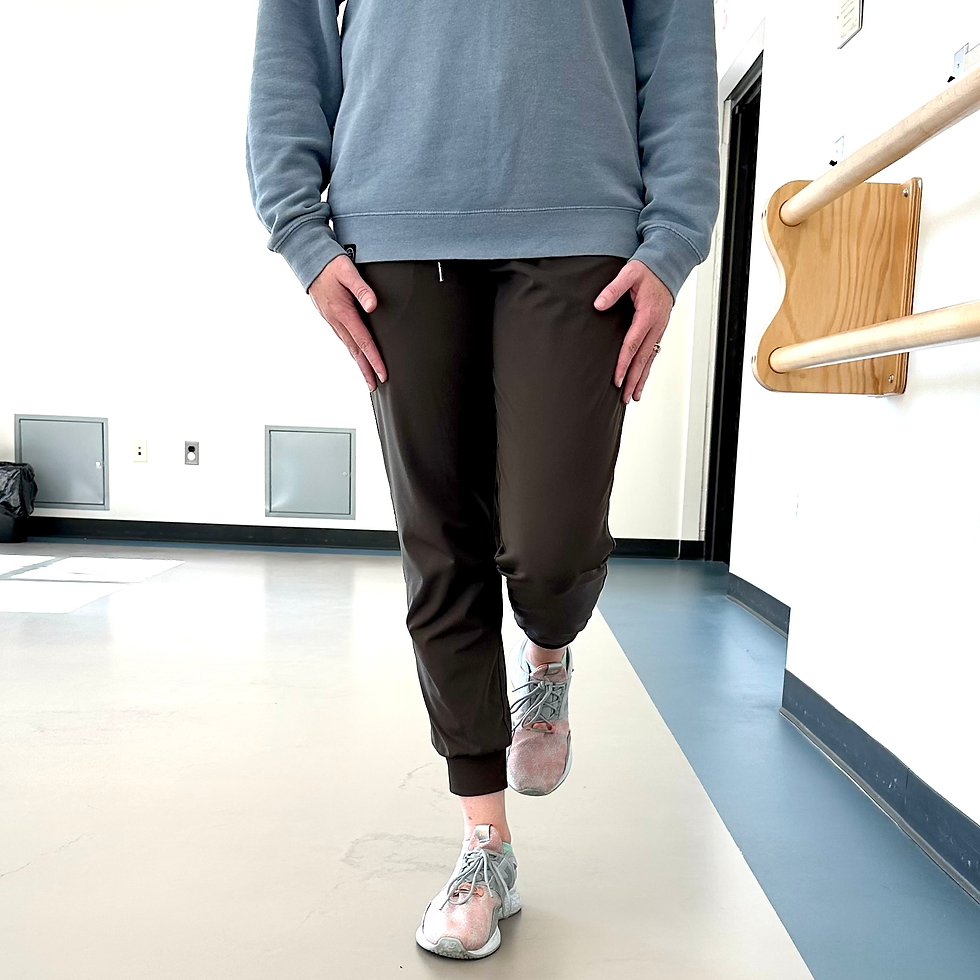
1. Ankles: Your First Stabilizers
Strong, responsive ankles help manage quick shifts and uneven surfaces.
Focus on:
Calf raises
Controlled ankle movements
Single-leg balance progressions
2. Hips: Power + Control
The hips are essential for:
Direction changes
Rotational control
Preventing excessive sway
Lateral stepping, resistance band work, and single-leg strengthening are especially effective. Here is an example of resisted sidestepping:
3. Reaction and Rotation

Balance isn’t just strength—it’s timing.
Training should include:
Turning while maintaining control
Reaching across the body
Dual-task activities (movement + thinking challenge)
Research supports task-specific balance training as more effective than general exercise alone for reducing fall risk and improving confidence (Sherrington et al., 2011). This means that your exercise should be simulating the activity you are hoping to improve with. Think about the difficult movements associated with your sport and break the movement down for practice.
Why Generic Exercise Isn’t Always Enough
Many active adults exercise regularly but still feel unsteady during sport.
That’s because:
Gym exercises are often straight-line
Machines reduce balance demand
Sport requires unpredictable movement
Balance improves most when exercises reflect real-life and sport-specific challenges, especially when done in the home or natural environment (Horak, 2006). Exercising in your own environment can make all the difference.
Next Steps: Build Balance That Supports the Activities You Love
If you want to stay confident playing golf or pickleball, the goal isn’t to “be careful”—it’s to train smarter.
✅ Start with the Better Balance Workbook
This free resource includes simple, progressive exercises you can do at home to improve stability, strength, and confidence.

📞 Schedule a Complimentary Consultation
Ask questions, discuss your goals, and see whether concierge mobile physical therapy is a good fit—no pressure, no obligation.
At Dawn Thomas Physical Therapy, we help active adults improve balance in ways that actually translate to daily life and the activities they enjoy most.
References
Horak, F. B. (2006). Postural orientation and equilibrium: what do we need to know about neural control of balance to prevent falls? Age and Ageing, 35(S2), ii7–ii11.
Maki, B. E. (1997). Gait changes in older adults: predictors of falls or indicators of fear? Journal of the American Geriatrics Society, 45(3), 313–320.
Sherrington, C., et al. (2011). Exercise to prevent falls in older adults: an updated meta-analysis and best practice recommendations. New South Wales Public Health Bulletin, 22(3–4), 78–83.
Shumway-Cook, A., & Woollacott, M. (2012). Motor Control: Translating Research into Clinical Practice. Lippincott Williams & Wilkins.
About The Authors

Dr. Dawn Thomas, DScPT, OMPT is a Doctor of Physical Therapy with 30 years of experience. She provides private concierge mobile physical therapy and wellness services across Metro Detroit. She specializes in helping people build strength, resilience, and confidence — bridging rehab, performance, and long-term mobility so clients can keep doing what they love at every age.

Dr. Melissa Tye PT, DPT, NCS is a board-certified neurologic doctor of physical therapy passionate about helping people restore movement and achieve their wellness goals through the power of exercise. In addition to her work in physical therapy, Mel also works in healthcare marketing research, speaking directly with consumers to better understand them. Whether it's PT or MR, she feels it is important to achieve a partnership and deep understanding of a client's goals.


Comments